Meet the UNYX team at Money2020, Vegas on 18-21 Oct.MEET UNYX →
×

Meet the UNYX team at Money2020, Vegas on 18-21 Oct.MEET UNYX →
UNYX connects regulated financial institutions so they can settle cross-border payments directly for faster, cheaper and compliant transfers.

Tell us the corridors, currencies, and volumes you need. We tailor onboarding to your institution instead of a one-size-fits-all setup.

Mutual due diligence, both ways: we verify your license and compliance program, and you verify ours, before a single transaction moves.

Send, receive, and hold multi-currency, multi-token, and stablecoin balances, and earn on the flow that moves through your corridor.

Go live through the Member Portal, a direct API, or a chat-based interface, whichever fits how your team already works. The snippet above is a live read straight from the ledger.
Request Sandbox docs →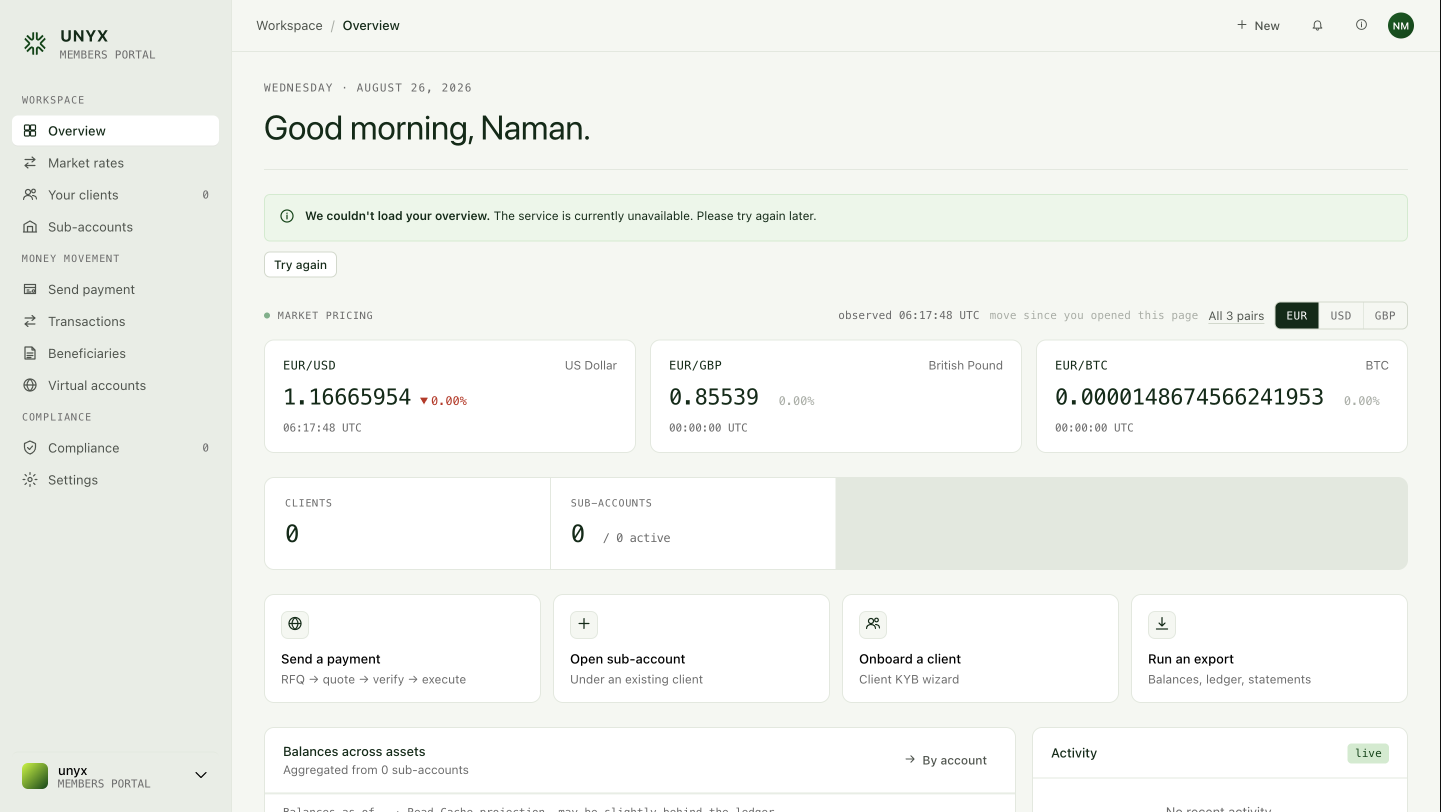
Three different ways institutions move money across borders today, each with a different answer to who's allowed in, who's liable for compliance, and who actually earns from the transaction.
Comparison criteria | UNYX Built for regulated institutions | Correspondent banking (SWIFT-messaged) | Closed-loop stablecoin systems |
|---|---|---|---|
Settlement model | Direct peer-to-peer settlement on a shared ledger, no intermediary chain | Payment routes through a chain of intermediary banks, each hop adds time and cost | Direct on-chain settlement, no intermediary chain |
Who can participate | Regulated, KYC/AML-verified financial institutions only | Only a few banks with a correspondent relationship | Anyone with a wallet, no licensing required |
Compliance & data security | ISO 27001, SOC 2 Type II, GDPR, every member verified once and recognized network-wide | Compliance is fragmented, each bank in the chain handles its own KYC independently | Typically pseudonymous, compliance is optional or absent by design |
Business model | Members earn from the corridors they open, settlement is a revenue line, not just a cost | Smaller banks pay fees upstream to correspondent banks; it's a cost line, not a revenue line | Speculative, no structural mechanism for institutional revenue share |

Copyright ©️ 2026 UNYX AI LTD. All rights reserved.
UNYX AI CA LTD (Ontario Corporation No. 1001253500), a wholly owned subsidiary of UNYX AI LTD (United Kingdom, Companies House No. 16786021), is registered with the Financial Transactions and Reports Analysis Centre of Canada (FINTRAC) as a Money Services Business under registration number C10001322 for foreign exchange dealing, money transferring, and dealing in virtual currency. UNYX AI CA LTD is also registered with the Bank of Canada as a Payment Service Provider under the Retail Payment Activities Act.
UNYX AI CA LTD is not a bank. It does not accept deposits and funds held are not insured by the Canada Deposit Insurance Corporation. Services are provided to regulated financial institutions and are not available to retail consumers.
Virtual assets are not legal tender in Canada, their value can fluctuate, and they are not covered by deposit insurance or investor protection schemes.
Registered office: 251 Consumers Road, Suite 1200, North York, Ontario, M2J 4R3, Canada.
UNYX AI operates a network of independently licensed and regulated financial institutions. UNYX AI itself is not a bank, e-money institution, or payment institution, and does not hold client funds. Products and services made available through the network are provided by member institutions under their own regulatory licenses in their respective jurisdictions and may not be available in all regions.
.svg)